
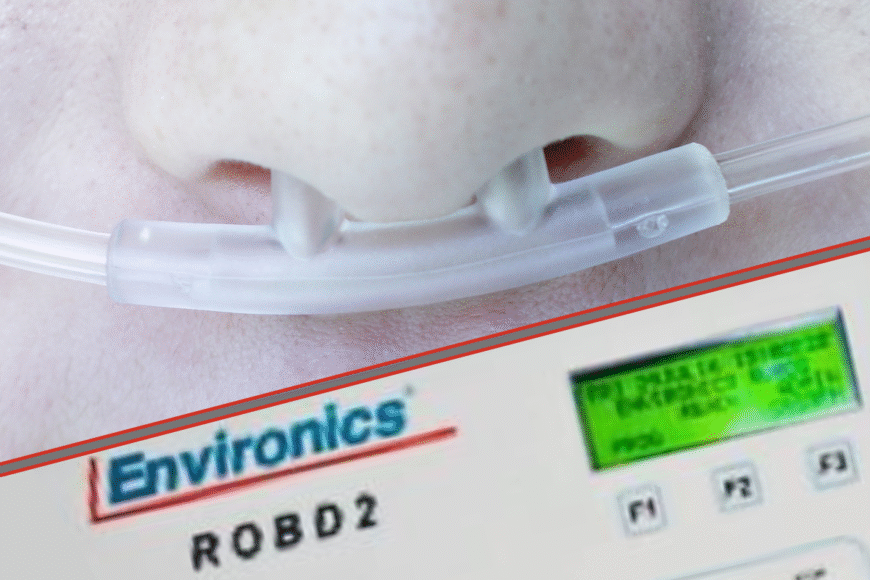
Human physiology relies on an oxygen pressure gradient that transports oxygen from ambient air to the mitochondria, sustaining aerobic metabolism. Hypoxia arises when that gradient is reduced, limiting cellular energy availability and triggering compensatory responses across multiple physiological systems. For researchers, the challenge lies not in generating hypoxia, but in defining it precisely enough to support confident measurement. Effective hypoxia research necessitates the use of a stimulus that is stable, repeatable, and isolated from pressure-related confounders. The ROBD2 fulfills this role by providing a tightly controlled normobaric environment for the investigation of oxygen deprivation.
Atmospheric physics and the normobaric model
All hypoxia research is governed by the behavior of gases under pressure. In a normobaric environment, total barometric pressure remains constant while the fraction of inspired oxygen is deliberately reduced. Under Dalton’s Law of Partial Pressures, decreasing oxygen concentration lowers its partial pressure without altering ambient pressure. Separating oxygen partial pressure from ambient pressure allows physiological responses to be attributed specifically to hypoxic exposure.
Hypobaric exposure does not preserve the separation between oxygen partial pressure and ambient barometric pressure. Reductions in ambient pressure simultaneously alter oxygen availability, gas volumes, diffusion gradients, and the performance characteristics of physiological measurement systems. These pressure-driven effects introduce additional variables that complicate interpretation when the research objective is to isolate biological responses to reduced oxygen partial pressure.
Normobaric hypoxia eliminates pressure-related influences by maintaining constant barometric pressure and manipulating only the inspired oxygen fraction. With barometric pressure held constant and oxygen concentration selectively reduced, oxygen partial pressure becomes the sole experimental variable. Observed changes in ventilation, circulation, or gas exchange can therefore be linked directly to hypoxic stress rather than secondary physical effects associated with decompression.
The ROBD2 applies these principles through precisely controlled nitrogen dilution. Oxygen is displaced in defined proportions, producing a mathematically specified equivalent air altitude while ambient pressure remains unchanged. Consequently, researchers can reproduce targeted hypoxic conditions with confidence, from moderate reductions in oxygen availability to severe hypoxic stress approaching high-altitude limits.
Physiological responses under controlled hypoxia
Physiological adaptation to hypoxia follows nonlinear dynamics, most clearly described by the oxyhemoglobin dissociation curve. Along its steep region, relatively small reductions in oxygen partial pressure produce disproportionally large declines in arterial oxygen saturation. Accurate characterization of the relationship between oxygen partial pressure and arterial oxygen saturation requires a hypoxic stimulus that remains stable over time.
The ROBD2 allows investigators to hold inspired oxygen at fixed levels, enabling subjects to reach steady-state hypoxia. Stable exposure conditions support detailed evaluation of ventilatory control, heat rate behavior, and oxygen transport efficiency. Instead of interpreting brief or fluctuating desaturation events, researchers can examine how the body establishes a new physiological equilibrium during sustained oxygen limitation. As steady-state hypoxia is established, reductions in arterial oxygen tension increase signalling from peripheral chemoreceptors in the carotid bodies to the brainstem. This chemosensory input drives coordinated adjustments in ventilation depth, breathing frequency, and sympathetic activity. Controlled exposure using the ROBD2 enables the systematic quantification of these integrated responses across defined levels of hypoxic stress.
Characterizing individual hypoxic tolerance
Interindividual variability plays a central role in hypoxia research as individuals exposed to identical inspired oxygen concentrations often exhibit wide differences in arterial oxygen saturation, ventilatory response, and tolerance limits. Interpreting such variability requires precise alignment between delivered gas composition and real-time physiological measurement. The ROBD2 pairs controlled oxygen delivery with continuous oxygen analysis and pulse oximetry, enabling direct comparison between inspired oxygen concentration and arterial saturation. This correlation allows researchers to identify response inflection points that indicate declining physiological research. These individualized response profiles are particularly valuable in aerospace physiology, human performance research, and clinical risk assessment.
Molecular accuracy through thermal mass flow control
Reliable hypoxia research depends on ensuring that a selected oxygen setting represents a consistent molecular stimulus. Volumetric gas delivery systems vary with temperature and pressure, introducing subtle shifts in delivered oxygen concentration. The ROBD2 avoids the temperature- and pressure-dependent variability of volumetric gas delivery through thermal mass flow control, which regulates gas delivery based on molecular mass rather than volume. As a result, a defined oxygen setting corresponds to a fixed number of oxygen molecules delivered per unit time, independent of environmental conditions. NIST-traceable calibration anchors oxygen concentration accuracy to external reference standards, while an internal gas reservoir stabilizes gas flow during periods of high respiratory demand, preventing transient fluctuations that could influence breathing mechanics or gas exchange measurements.
Clinical applications and recovery kinetics
Hypoxia research encompasses both oxygen deprivation and the dynamics of recovery that follow. Re-oxygenation kinetics offer direct insight into cardiovascular reserve, pulmonary gas exchange efficiency, and metabolic resilience. The ROBD2 enables controlled transitions from hypoxic gas mixtures to elevated inspired oxygen, allowing recovery trajectories to be measured with temporal precision.
Neurological applications are particularly sensitive to changes in oxygen availability and re-oxygenation rate. Because cerebral function depends on continuous oxygen delivery, controlled hypoxic exposure permits systematic evaluation of cognitive impairment onset, while recovery measurements quantify the rate and extent of functional restoration as oxygen availability increases. Such data informs clinical assessment and operational decision-making in aviation and spaceflight.
When hypoxia is studied in human subjects, safety and experimental control become inseparable considerations. Normobaric hypoxia delivered by the ROBD2 offers a safer and more repeatable alternative to traditional altitude chambers, enabling medically supervised protocols and maintaining physiologically meaningful hypoxic exposure.
Advancing hypoxia research with the ROBD2
Developed by Environics Inc., the ROBD2 provides a controlled normobaric platform for hypoxia research requiring precise oxygen delivery and repeatable experimental conditions. Its design integrates accurate gas control, calibrated measurement, and safety features to support rigorous investigation of human physiological responses to reduced oxygen availability. To learn more about the ROBD2, contact Environics Inc. for a technical consultation.