
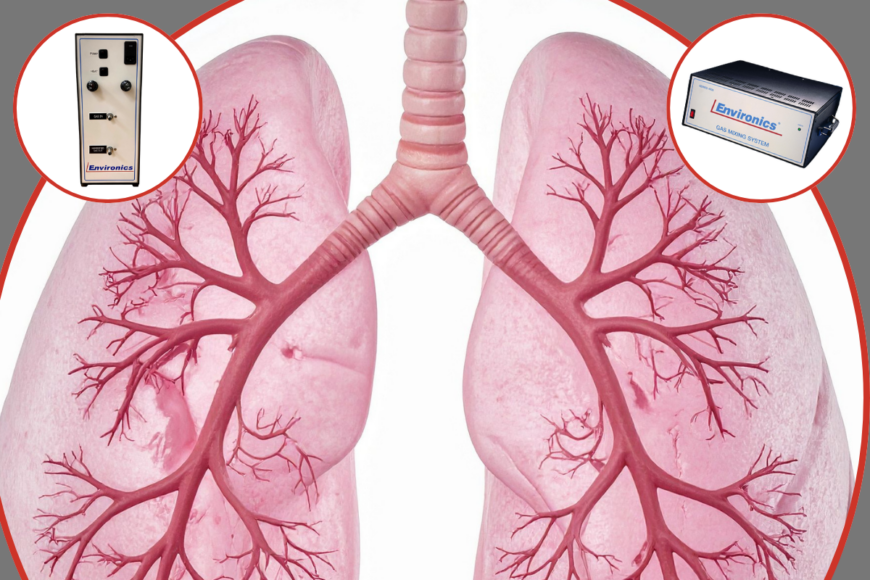
Inside the human respiratory system, inhaled air is rapidly transformed into a warm, moisture-rich gas mixture before reaching the lower airways. Medical gas testers must replicate these conditions to evaluate how ventilators, humidifiers, and respiratory monitoring systems behave during actual patient use. This requires far more than adding moisture to a gas stream. Modern gas testing systems must carefully regulate vapor concentration, gas temperature, pressure, and flow dynamics to reproduce lung-like humidity conditions with stability, precision, and repeatable performance.
Physiological Requirements for Medical Gas Delivery
The human respiratory system operates within a narrow environmental range. Before inspired gas reaches the lower airways, it is typically warmed to 37°C and conditioned to 100% relative humidity (RH). By warming and humidifying inhaled gas, the respiratory tract protects airway tissues and supports efficient gas exchange.
Medical gases supplied from compressed cylinders or centralized hospital systems are naturally dry. Without humidification, prolonged exposure to these gases can damage the respiratory tract. Dry gas delivery may contribute to the desiccation of the mucosal lining, impaired mucociliary clearance, thickened secretions, and increased infection risk.
Modern respiratory devices must perform reliably in humidified critical care environments, where dry-gas testing alone cannot accurately represent clinical performance. Sensors, humidifiers, and flow systems must be validated under conditions that closely resemble the physiological environment of the lung.
How Medical Gas Testers Replicate Lung Humidity
Advanced medical gas testers simulate lung humidity through controlled vapor generation. Instead of relying on inconsistent bubbling methods, they introduce deionized water into a dry carrier gas stream with precision evaporation or injection processes.
The objective is to generate a stable, fully vaporized humidity stream without introducing liquid droplets that could disrupt sensor accuracy or flow measurements. Controlled vaporization maintains consistent moisture levels across changing flow rates and gas mixtures, allowing respiratory devices to be evaluated under repeatable clinical conditions.
Temperature management is equally important. Water vapor condenses rapidly if the gas temperature falls below its dew point. To prevent condensation, medical gas testers use heated internal pathways and delivery tubing that preserve stable thermal conditions throughout the system.
Beyond vapor generation, mass flow integration helps stabilize humidity levels during respiratory testing. Medical gas testers continuously adjust water vapor delivery in response to changes in gas flow rate and temperature accurate RH levels.
Collectively, vapor generation, thermal management, and mass flow integration allow medical gas testers to reproduce near-saturated respiratory environments between 95% and 100% RH. Engineers can then evaluate high-flow respiratory equipment within physiologically realistic humidified environments.
The Mechanism of Humidity Simulation
Replicating lung humidity requires careful control of gas flow, temperature, and water vapor delivery. Medical gas testers recreate these respiratory environments by introducing precise amounts of water vapor into dry carrier gases. Temperature plays a major role in this process because it directly affects how much moisture a gas can hold. Even small temperature changes can shift relative humidity (RH) levels and reduce measurement accuracy.
To keep humidity stable throughout testing, medical gas testers continuously monitor temperature, pressure, flow rate, and vapor concentration. The equipment then adjusts gas flow and water vapor delivery in real time to compensate for changing operating conditions. Continuous regulation helps maintain consistent RH levels during extended respiratory testing and supports more reliable sensor and flow measurements.
Challenges in Replicating the Lung Environment
Achieving lung-like humidity presents several engineering challenges, as respiratory testing operates close to the condensation threshold. Small temperature fluctuations can cause water vapor to condense inside tubing, sensors, and flow pathways, disrupting the stability of the gas stream and reducing measurement accuracy. Preventing condensation therefore becomes essential for supporting reliable respiratory test performance under high-humidity operating environments.
Saturated respiratory environments can also influence sensor behavior directly. Oxygen and carbon dioxide sensors may respond differently under high-moisture operating environments due to changes in gas density and thermal conductivity. Respiratory devices frequently operate continuously for long periods in clinical settings, generating additional demands on testing equipment. Long-duration clinical testing further increases these stability demands, requiring medical gas testers to deliver precise humidity control over extended operating cycles without drift, fluctuation, or condensation-related instability.
Industrial and Clinical Applications
Medical gas testers use humidity simulation to evaluate respiratory equipment in clinically realistic operating environments.
- Ventilator testing- manufacturers assess airflow measurement accuracy, pressure regulation, and respiratory gas delivery within humidified breathing circuits.
- Humidifier and HME evaluation- heated humidifiers and heat and moisture exchangers (HMEs) undergo analysis for moisture transfer efficiency, thermal performance, and resistance to condensation.
- Respiratory device development- research teams apply controlled humidification during the design of respiratory interfaces, aerosol delivery technologies, nebulizers, and inhalation therapy systems.
Engineering Stable Humidity for Respiratory Device Testing
Environics Inc. integrates precise humidity control into respiratory gas testing systems used for medical device validation and research. The Series 4000 Multi-Component Gas Mixing System can be configured for humidified respiratory applications such as aerosol delivery studies and ventilator development workflows, while the Series 500 Stand-Alone Humidification System provides dedicated moisture generation for independent test environments such as ventilator calibration benches and respiratory sensor development labs. Combined with accurate mass flow regulation and heated gas delivery pathways, our technologies help manufacturers generate stable, lung-simulated operating conditions for ventilator, humidifier, and respiratory device analysis. Contact Environics Inc. now to learn more about our humidification technologies and how they can enhance your respiratory testing capabilities.