
The purity of an instrument’s gas supply becomes increasingly important as analytical measurements move into the parts per billion (ppb) and parts per trillion (ppt) range. For gas chromatography with flame ionization detection (GC-FID) and total organic carbon (TOC) analysis, even small quantities of hydrocarbons, moisture, or particulates in supplied air can affect baseline quality and measurement sensitivity. Catalytic zero air generators reduce these contaminants at the source, providing cleaner air for reliable trace-level analysis.
The Invisible Threat of Baseline Noise
During GC-FID analysis, separated volatile organic compounds enter a hydrogen-air flame, where combustion produces ions that generate an electrical signal proportional to the quantity of carbon reaching the detector. Hydrocarbons already present in burner air also combust. Their contribution elevates the baseline, increases noise, and makes small chromatographic peaks harder to distinguish from background variation.
Similarly, TOC analysis can be influenced by carbon impurities introduced through carrier or catalyst air. Trace contamination becomes particularly important during ultrapure water analysis, environmental water monitoring, and low-carbon process testing, where small background contributions can distort blank values or complicate differentiation between total inorganic carbon (TIC) and TOC.
Traditional gas supplies introduce several potential variables:
- Gas cylinders add recurring rental, delivery, storage, and changeover requirements, with purity potentially varying between supplies
- Standard compressors can introduce oil mist, organic residues, particulates, and changing moisture levels into downstream gas lines
Analytically, greater background noise reduces the signal-to-noise (S/N) ratio. Low-concentration peaks consequently become harder to separate from normal baseline fluctuation, which can raise the practical limit of detection (LOD) and compromise trace-level data.
How a Catalytic Zero Air Generator Purifies Compressed Air
A catalytic zero air generator converts an incoming air stream into dry, hydrocarbon-reduced analytical air through sequential purification processes. Its architecture targets several contaminant classes because no single purification mechanism addresses moisture, particles, oil residues, and volatile hydrocarbons equally well.
First, pre-filtration and moisture separation remove liquid droplets, oil mist, and particulates. Pressure swing adsorption (PSA) or molecular sieve technology can then reduce water vapor, producing the sub-zero dew points needed for stable analytical gas delivery.
Next, high-temperature catalytic oxidation targets total hydrocarbons (THC). Compressed air passes across a specialized catalyst heated to roughly 300°C-450°C. Here organic contaminants undergo oxidation to carbon dioxide and water. Catalytic treatment can address persistent compounds such as methane, which are difficult to remove using conventional filtration alone.
Finally, high-efficiency particulate filtration captures residual microscopic material before purified air reaches the instrument. Such polishing protects narrow flow paths, valves, columns, and detector components from particle contamination.
How Catalytic Purification Reinforces GC-FID and TOC Sensitivity
For GC-FID, a zero air generator tackles background hydrocarbons prior to them entering the detector flame. Supplying air with total hydrocarbon concentrations below 0.02 ppm can reduce baseline offset, leaving low-level analytical peaks more distinct from background response. Clearer separation between signal and noise supports peak integration when laboratories quantify trace volatile organic compounds.
Beyond baseline stability, cleaner burner air can limit organic contamination entering GC flow paths. Fewer unwanted hydrocarbons reduce the potential for contaminant accumulation and subsequent elution as ghost peaks, helping chromatograms more accurately represent compounds originating from the sample.
Enhanced baseline stability also strengthens the S/N ratio. Because the practical lower limits of quantification (LLOQ) are influenced by how clearly an analyte response can be distinguished from noise, controlling gas purity gives analytical chemists another way to protect sensitivity without changing the sample itself.
Within TOC analysis, gas purity affects a different part of the measurement. Carbon contamination introduced through carrier air can contribute to blank values, making zero-point calibration less representative of the sample background. A catalytic zero air generator reduces unwanted organic input from the gas stream and supports measurements of very low carbon concentrations.
Accurate TIC and TOC differentiation benefits as well. In ultrapure pharmaceutical water testing, semiconductor-grade water monitoring, and environmental water analysis, external carbon entering through supplied air can inflate measured values. Reducing the source of external carbon helps ensure reported carbon concentrations reflect the sample more closely.
Operational and Economic Value for the Laboratory
On-demand zero air generation can simplify routine laboratory gas management. A zero air generator provides a continuous local supply, reducing interruptions caused by depleted cylinders during long chromatographic sequences or scheduled TOC monitoring.
Operational advantages include:
- Reduced cylinder rental, delivery, replacement, and inventory costs
- Less staff time spent moving and changing high-pressure cylinders
- Fewer interruptions to scheduled analytical workflows
- Reduced high-pressure gas storage and handling inside laboratories
Over longer operating periods, eliminating recurring cylinder logistics can offset the initial investment in a zero air generator. Laboratories also improve control over how analytical air is produced and supplied to instruments.
Maintaining Zero Air Purity for Sensitive Analysis
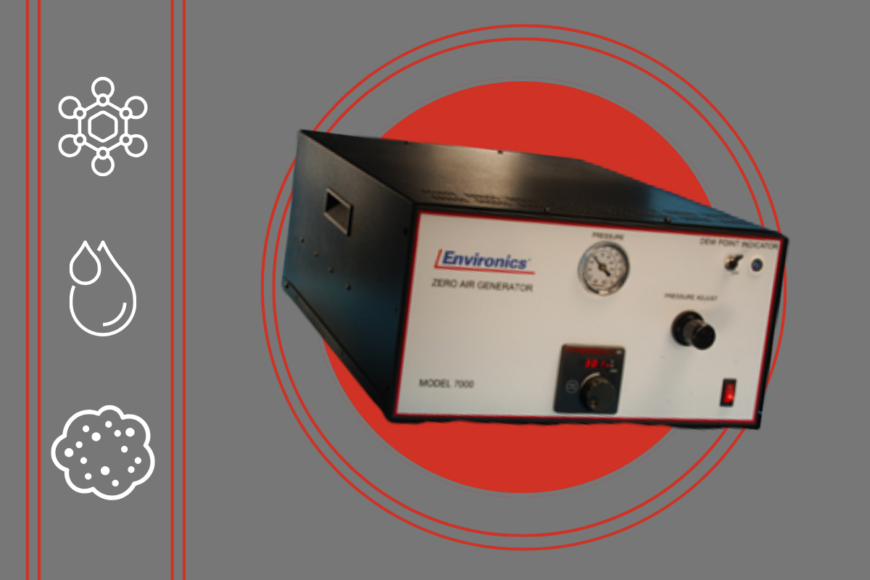
Environics, Inc. offers the Series 7000 Stand-Alone Zero Air Generator for laboratories seeking a continuous source of dry, contaminant-controlled air. Delivering up to 20 standard liters per minute (SLPM), the system combines an internal oil-less piston pump, pressure swing adsorption (PSA) molecular sieve technology, visual moisture indicators, dual pressure regulation, automatic demand control, and an optional heated catalytic converter capable of reducing hydrocarbons below 0.02 ppm. For GC-FID, TOC, and other trace analytical workflows, the Series 7000 Stand-Alone Zero Air Generator provides a practical route to tighter control over gas purity and baseline performance. Connect with Environics, Inc. now to evaluate your current zero air generator setup and discuss the best configuration for your analytical workflow.