
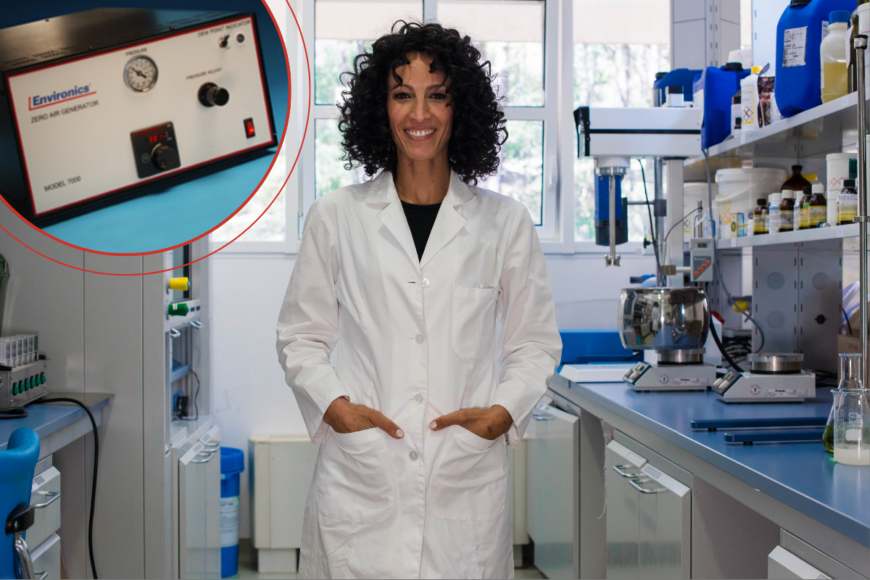
High-precision analytical applications like flame ionization detection (FID), gas chromatography (GC), and ambient air calibration require a stable supply of ultra-pure zero air to minimize background interference and deliver accurate, reproducible measurements. When selecting an air generator, laboratory managers must decide whether the system will receive compressed source air from a central air line or use an integrated compressor to produce it at the point of use. This choice can affect air purity, system reliability, maintenance requirements, and operational flexibility.
Connecting to a Central Compressed Air Line
Facilities with an established compressed air network can use that supply to feed an air generator equipped with secondary purification scrubbers and dryers. Since the primary compressor already serves the building or plant, laboratories tend to avoid adding another compression system at the point of analysis.
Two practical benefits make central compressed air useful:
- Capital cost- existing compression infrastructure can reduce upfront air generator expenditure, particularly when suitable connections already reach the laboratory
- Acoustics and space- keeping compression equipment elsewhere limits mechanical noise and compressor heat near analytical instruments. It also preserves valuable laboratory space for gas chromatographs, calibration systems, and sample preparation equipment
However, source-air composition necessitates careful evaluation before connecting an air generator to house air. Industrial compressed air can carry moisture, lubricating oil aerosols, rust, particulates, and pipe scale. Heavy moisture loading places greater demand on drying materials and may shorten purification media service intervals.
Additional operational risks include:
- Contamination cascades- Oil, moisture, and particulate contamination can increase stress on downstream scrubbers and other components responsible for producing zero-grade air
- Pressure fluctuation- Shared compressed air networks frequently serve equipment throughout a facility. Available pressure may fall as other processes cycle, potentially affecting sensitive analytical operations and detector baseline stability
- Facility dependence- Scheduled maintenance or an unexpected outage affecting the central air network can interrupt FID, GC, and ambient air calibration workflows relying on that supply
Gas Generators With Integrated Compressors
Self-contained air generator systems use an internal compressor to draw ambient laboratory air, compress it, and feed it directly into the purification train. Such an arrangement provides a dedicated compressed air source at the point of use without relying on a building-wide distribution network.
Several characteristics distinguish the integrated approach:
- Total autonomy- An integrated air generator can operate independently of central compressed air infrastructure. This flexibility is valuable for remote testing stations, mobile laboratories, temporary monitoring installations, and facilities with unreliable house air
- Controlled intake- Internal oil-less piston pumps process ambient laboratory air without introducing lubricant aerosols from industrial compression equipment. Lower contamination loads can help protect catalytic scrubbers, pressure swing adsorption (PSA) molecular sieves, and other purification components
- Automated pneumatic control- Modern systems can cycle the compressor according to analytical demand. Limiting unnecessary operating hours can reduce mechanical wear and support longer pump and scrubber service intervals
Mechanical components introduce a different maintenance profile. Internal pumps generate heat during compression, and thus seals, intake filters, and other wear components need scheduled preventive servicing. Laboratory managers must weigh this predictable workload against the external filtration and facility coordination involved with central compressed air.
The Decision Matrix: Evaluating Your Lab’s Infrastructure
Choosing an air generator architecture involves more than comparing equipment costs. Laboratory managers can evaluate five operational criteria to determine which supply arrangement fits their analytical environment:
- Air quality and baseline stability- Does the central supply provide consistently oil-free, low-moisture compressed air, or could variable contaminants increase purification demands and affect analytical baseline stability?
- Facility mobility and flexibility- Will the air generator remain permanently installed, or must it support mobile air monitoring, field calibration, temporary laboratories, or changing instrument locations?
- Redundancy and uptime requirements- Can FID, GC, or ambient air calibration workflows tolerate interruptions when central compressed air undergoes maintenance or experiences an outage?
- Maintenance infrastructure- Is the laboratory better equipped to service an internal compressor on a planned schedule or manage external pre-filtration and source-air quality on a shared line?
- Space and acoustic limits- Can the laboratory accept local compressor noise, heat, and equipment footprint, or is keeping mechanical compression outside the analytical space a priority?
The answers to these questions position the air generator within the laboratory’s wider infrastructure strategy. Laboratories with stable, clean house air may gain efficiency from an existing network. Operations prioritizing independence, mobility, and direct control over feed conditions may benefit more from an integrated compressor.
Adapting Zero Air Generation to Your Laboratory
Environics, Inc. has developed the Series 7000 Zero Air Generator with flexible source-air configurations to suit different laboratory specifications. Delivering up to 20 standard liters per minute (SLPM) of dry, contaminant-free air, the Series 7000 Zero Air Generator removes water vapor, particulates, sulfur dioxide, nitrogen oxides, ozone, carbon monoxide, and hydrocarbons. Laboratories can select a stand-alone configuration with an internal oil-less piston pump and automated demand-cycling ballast tank or use an existing compressed air source. A color-changing moisture indicator and compact 19-inch rack-mountable footprint also support stationary and mobile laboratories. Speak with Environics, Inc. for more information about the Series 7000 Zero Air Generator.