
Total cost of ownership (TCO) for zero air extends well beyond the price of the gas itself. In laboratories and monitoring facilities, supplying ultra-high-purity zero reference air can generate costs associated with deliveries, cylinder handling, maintenance, energy consumption, equipment downtime, facility space, and operator time. Examining these variables together helps establish the broader financial implications of on-demand generation for flame ionization detector (FID) operation, ambient air calibration, continuous emission monitoring (CEM), and other analytical workflows.
Moving Beyond High Bottled Gas Overhead
Bottled zero air carries direct expenses that continue for as long as cylinders remain part of the gas supply strategy. Purchase or refill charges may be accompanied by cylinder rental, demurrage, hazardous delivery surcharges, and supplier price fluctuations. Consequently, annual expenditure can vary with consumption rates, contract terms, delivery frequency, and changes across the industrial gas market.
Operational labor adds another layer to the TCO. Personnel must monitor inventory, place orders, receive deliveries, move heavy pressurized cylinders safely, connect replacements, and manage empty vessels. Such activities can divert technical staff from analytical work, instrument maintenance, emissions monitoring, and other higher-value responsibilities.
Residual gas represents a less visible source of waste. Operators rarely drain cylinders completely because maintaining positive pressure helps reduce the risk of back-contamination. Facilities thus pay for gas that remains inside returned vessels. Cylinder replacement can also interrupt critical CEM measurements, FID analyses, or calibration sequences if the supply reaches its changeover point during operation.
On-demand zero air generators alter this economic model by producing purified gas at the point of use. Removing routine cylinder deliveries reduces exposure to supply disruptions and recurring logistics expenses, leaving comparatively predictable electricity and maintenance costs. For facilities with sustained zero air demand, that shift can make long-term expenditure easier to manage.
The Operational Risk of Impurities and Downtime
Trace contamination can impose costs that extend further than the zero air supply itself. Hydrocarbons, sulfur dioxide (SO2), nitrogen oxides (NOx), and moisture may interfere with sensitive analytical instruments, contributing to baseline drift or inaccurate calibration. Correcting affected measurements may involve troubleshooting, recalibration, repeat testing, and additional technician hours.
Moisture presents an additional operational concern because accumulated water can compromise analytical components and pneumatically operated valves. Effective purification and drying inside zero air generators help limit contaminant transfer to downstream equipment, supporting stable operation across demanding measurement workflows.
Continuous compressor operation introduces a different expense. Pumps that run regardless of actual gas demand accumulate mechanical hours quickly, consume more electricity, and can reach maintenance or replacement intervals sooner. Frequent component servicing then increases both material costs and technician workload.
Demand-responsive operation provides a more efficient alternative to continuous compressor operation. Zero air generators equipped with storage capacity and automated power cycling can activate the compressor when pressure falls and stop it after demand has been satisfied. Combining controlled pump operation with effective purification reduces unnecessary energy consumption, limits mechanical wear, and protects instruments from contaminants that could disrupt analytical performance.
Integration, Footprint, and Labor Costs
Facility infrastructure also influences zero air TCO. Cylinder banks occupy valuable floor space and need suitable storage, handling access, and safety provisions. Additionally, centralized gas infrastructure may introduce extra costs through piping, installation, compressor equipment, and modifications needed to distribute air to analytical instruments.
Compact zero air generators can decrease the space and infrastructure requirements associated with cylinder-based gas supplies. Modular systems suitable for standard 19-inch rack installation or portable deployment allow laboratories and CEM facilities to position zero air production near the instruments it serves. Flexible placement can simplify installation and reduce the need for extensive facility alterations.
Alongside this, maintenance efficiency can lower the TCO of zero air generation. Systems demanding frequent manual diagnostics increase labor requirements, particularly across sites operating multiple analyzers. Visual diagnostic indicators, accessible pressure controls, and automated pneumatic functions ensure technicians have direct information about operating condition and service needs. Less time spent checking gas infrastructure ensures more technical resources are available for calibration, compliance monitoring, instrument servicing, and data quality activities.
Balancing Cost and Performance in Zero Air Generation
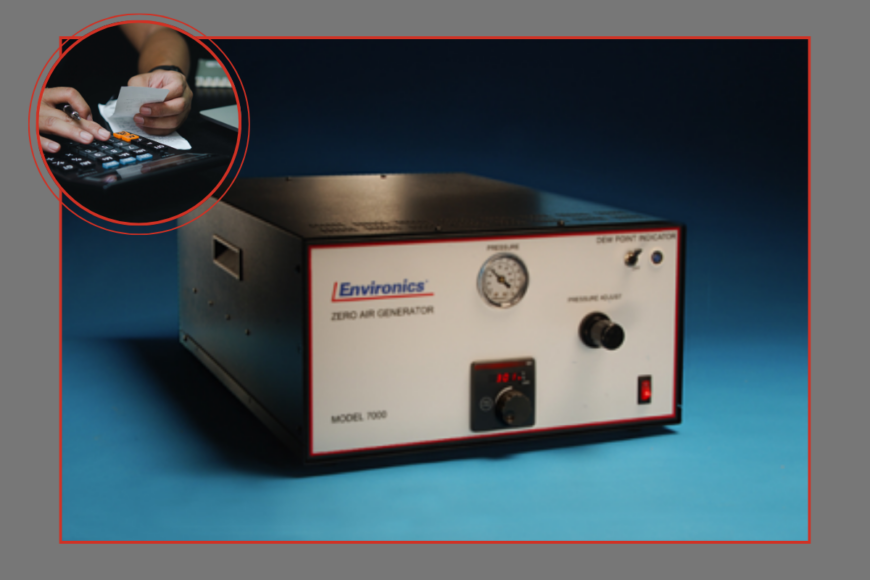
Managing zero air expenditure means looking beyond the purchase price of gas and generation equipment to consider purity, supply continuity, energy use, equipment life, labor, and infrastructure. Environics, Inc. addresses these operational requirements with the Series 7000 Stand-Alone Zero Air Generator, delivering up to 20 standard liters per minute (SLPM) at 30 pounds per square inch (PSI) with pressure swing adsorption (PSA) drying below -30°C, multi-pollutant scrubbing, an internal ballast tank, demand-based oil-less piston pump operation, visual maintenance indicators, and rack-mountable or portable configurations. Organizations reviewing their zero reference air strategy can contact Environics, Inc. to explore how our gas generation products can support efficient analytical and emissions monitoring operations.